

University Group Projects
In the last three years of my time during my study at the uni, we had several group projects that had to be done for grades or for temporary job roles, each acting as studios with their own names. Across all three of these projects, I was actually in a Github repository or Technical Design leadership position, so I feel that these gave me a great basis for my studio-level development skills. There was quite a lot I learned from each project, ranging from the technical needs of engine workarounds, to simply handling situations where teams don’t assemble as expected.
Above Your Pay Grade Productions –
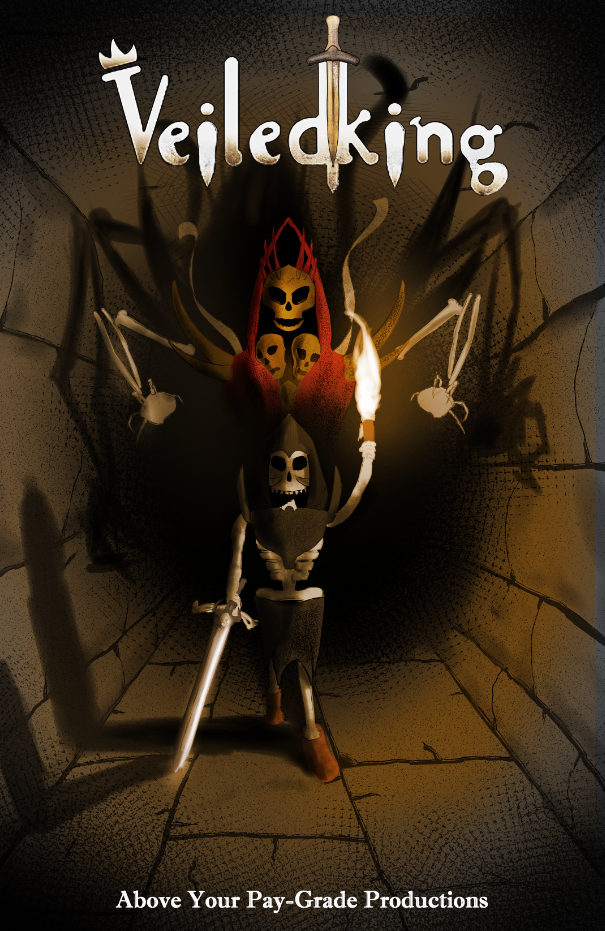
Veiled King

By far the most difficult of the projects I had team-worked on. However, this time around, a lot of my time was spent on assisting the developers I worked alongside, rather than developing features from the ground up for the project. Whilst in the early weeks I did prototype things for a framework to exist before artists and designers took hold, I eventually ended up needing more time to other studies. This caused a time constraint that pressured my leadership on the project. So some of the features I designed, such as Enemy Layout Randomness, got scrapped.

And so, most of my time ended up serving as Technical Supervisor, where I would go in and apply corrections to existing code or designs in order for the game to function as smoothly as we could get it. One of the main corrections I had made in the project was the layout of level designs. Originally designers proposed a more maze like approach to the level flow, however, since our main inspiration at the time was the 8-bit versions of The Legend of Zelda, I demonstrated using Cube Grid to develop levels with a boxy environment style that could be populated with themes afterward.

Oatcake Interactive –
Crab Sticks
The final project I worked on at the university I did not nearly have as much of an interesting role in, as I was needed most to assist scheduling programmers’ tasks and assisting the art and design teams into pipelining additions into the git repository. Since we were developing the game from the ground up, I also ensured that developers were documenting their new systems and any changes to them as they went. For if there was anything that I learned working on modding titles like Minecraft, it’s that full documentation about how each system worked and why they were made that way, would make it easier to pass the project on to the next team.
Group 2 –
Chaos Kart
With a lack of a senior design department, most of the game’s idea was fleshed out by a junior designer I worked closely with to ensure the game had the core it needed to feel like its intended vertical slice. Whilst most of my time was spent on Github, any time the designer had an idea for an item, I prototyped them on the track.

When I wasn’t busy prototyping, I was assisting Josie Conway develop the vehicle physics. Since we had moved away from using Chaos Vehicles in light of a lack of study on the tool, we developed our cartoonish motion from scratch. Not only did I help design the Drifting feature, but I also helped fix bugs. Turns out, if you develop your own spring force, setting the forces too high will break the game but only if it’s allowed to drop its frames per second below 30. The karts would bounce in place, and it looked quite silly and broke the game loop.
Leave a Reply